
Dissolved Oxygen Monitoring
Live oxygen readings from any river, lake or pond, alongside the pictures that show you why.
Dissolved oxygen is the single clearest measure of a water body's health. Fish, invertebrates and the plants they depend on all need it, and it can collapse in hours: a hot afternoon, a pollution event or a sudden bloom of algae can take a healthy river to the point where fish die before anyone is on site to see it.
The FloodEye camera system now reads dissolved oxygen directly. An optical probe sits in the water, wired to the camera, and the camera reports the concentration and saturation to the management portal on every report, with a low oxygen alarm that is raised the moment a reading crosses your trigger level. Because the readings arrive with the camera's own images, you see the water as well as the number: the colour, the weed, the flow, the discharge pipe that was running at the time.
Why Dissolved Oxygen Matters
Oxygen dissolves into water from the air above it and from the plants growing in it, and is used up by everything that lives, decays or is discharged into it. Healthy, cool river water holds around 8 to 11 milligrams of oxygen per litre. Most freshwater fish are under stress below 4 mg/L and at serious risk below 2 mg/L.
The level is rarely steady. It falls as water warms, because warm water holds less. It falls overnight, when plants stop producing oxygen and keep consuming it, so the lowest reading of the day is usually just before dawn, when nobody is watching. It falls sharply after organic pollution, such as slurry, sewage or silage liquor, as bacteria consume the oxygen while breaking it down. And it can swing the other way: on a sunny afternoon a weedy stretch can run well over 100 % saturation, a warning that the same stretch may crash to near zero that night.
A single spot reading, taken on a site visit in the middle of the day, misses nearly all of this. Continuous monitoring catches the overnight low, the response to a storm or a discharge, and the slow decline of a stretch under pressure, and it gives you the record to prove it.
8 to 11 mg/L. What clean, cool river water should hold.
Below 4 mg/L. Fish under stress. This is the alarm level as supplied.
Below 2 mg/L. Fish kills likely.
How It Works
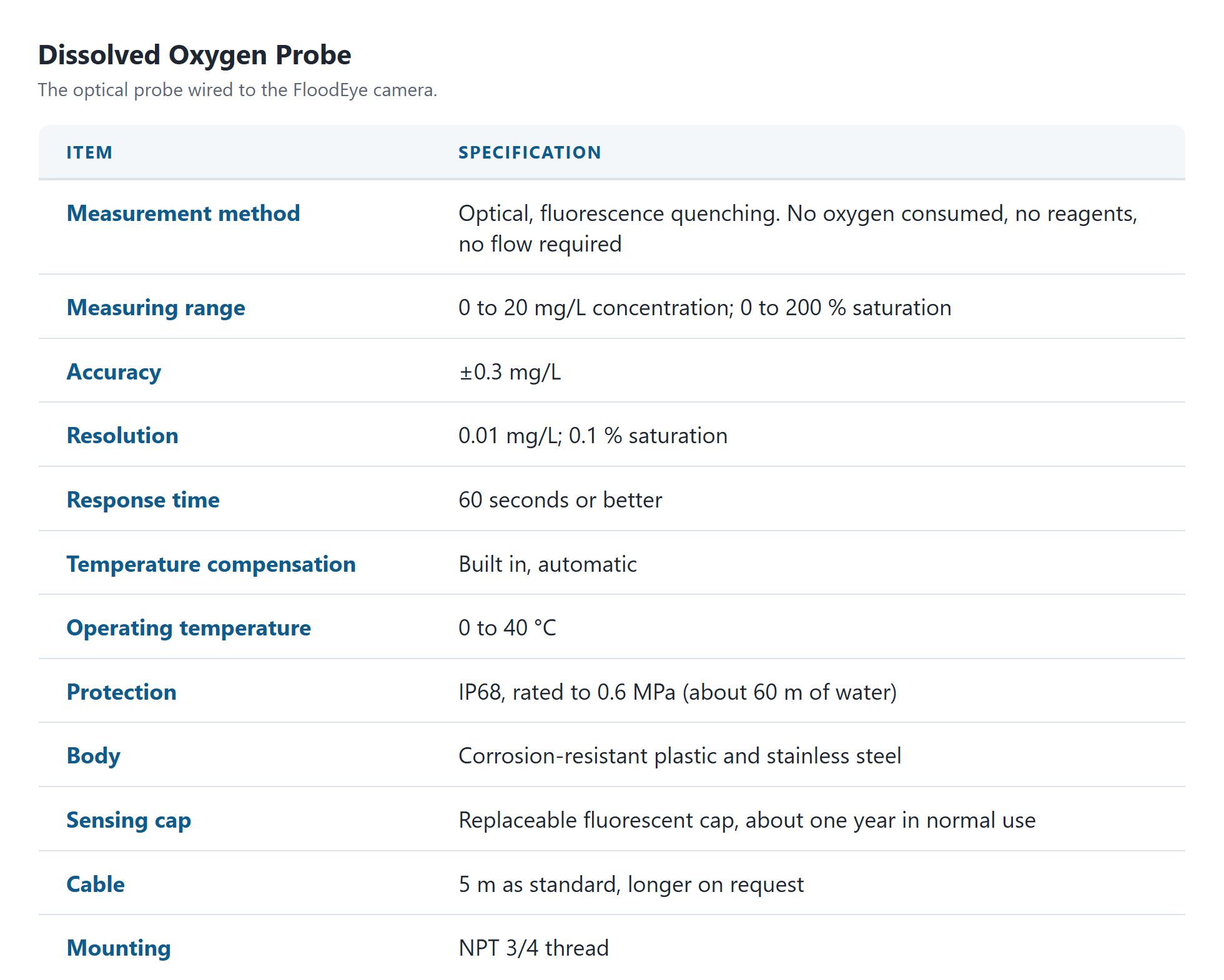
The probe is an optical sensor. A sensing cap on its tip holds a fluorescent layer that glows when a blue light inside the probe flashes on it; dissolved oxygen shortens that glow, and the probe measures the difference. Nothing is consumed and nothing is added to the water, so unlike the older electrochemical probes it needs no reagents, no flowing water across a membrane and no warm-up, and it is unaffected by hydrogen sulphide and by still water.
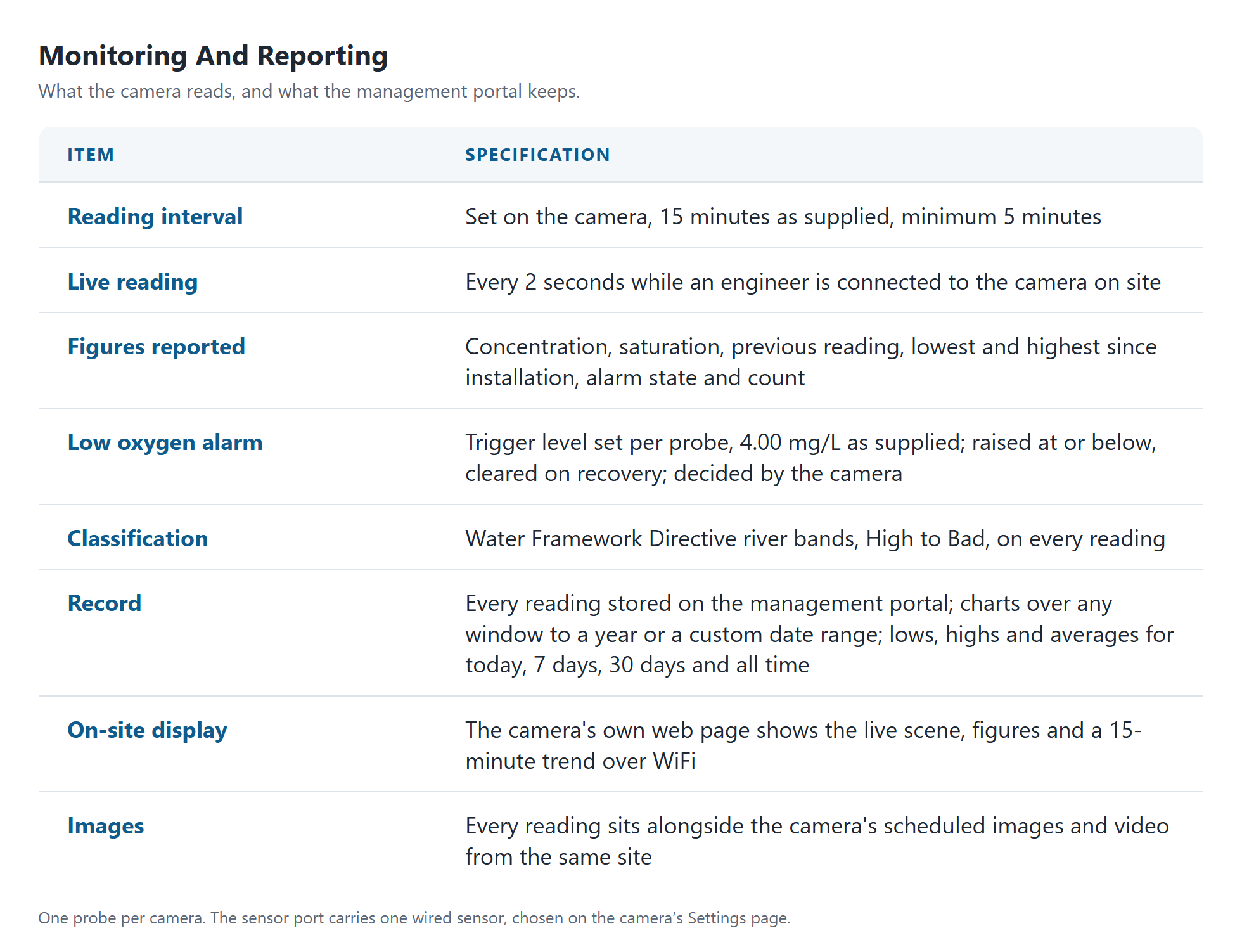
The probe is wired to the FloodEye camera's sensor port and powered from the camera, so there is no separate logger, battery or telemetry unit to install. The camera reads it on a schedule you set, typically every fifteen minutes, and sends each reading to the management portal with its regular report. When an engineer connects to the camera on site, the camera reads the probe every two seconds, so a reading can be checked, or the probe tested in a bucket, with the figures moving in front of you.
The probe reports two figures. Concentration, in milligrams per litre, is the amount of oxygen in the water. Saturation, as a percentage, is how much of the oxygen the water could hold at its temperature is actually there, which is the figure river standards are judged on. The probe compensates for water temperature itself.
One cable. Power and data both come from the camera. Nothing else to install.
Every fifteen minutes. Or any interval you choose, day and night.
A year between caps. The sensing cap is the only consumable and is replaced in minutes.
What You See
Every camera with a probe gets a Dissolved Oxygen page on the management portal, one click from the camera's own page. Open it and the first thing you see is the water itself: a live scene that colours the water to the oxygen it holds, from clear blue down to murky green, with the bubbles thinning out and a fish rising to the surface as the oxygen falls. One glance tells you whether the water is healthy before you read a number.
Beside the scene, four dials give the figures: the concentration against your alarm level, the saturation on a 0 to 200 % scale with 100 % marked, the previous reading with the change since, and the lowest reading since the probe was installed. A water quality card grades the latest reading on the official river standard, with a face that smiles or frowns accordingly.
The same picture is on the camera itself. Connect to the camera on site and its own web page shows the same scene, the same figures and a trend of the last fifteen minutes, with readings every two seconds, so an engineer standing at the water can see the probe respond as it goes in.
A picture of the water. The live scene shows the state of the water at a glance.
Every reading kept. Charts and records back to the day the probe went in.
The camera's view. Every reading sits beside the images taken at the same time.
Low Oxygen Alarm
Set a trigger level for each probe, 4 mg/L as supplied, on the camera's own page. The camera judges every scheduled reading against it. A reading at or below the level raises the alarm, and it clears only once the oxygen has recovered clearly above the level, so a reading hovering on the line does not raise and clear the alarm every few minutes.
The alarm is decided by the camera, in the field, and reported with every status report. On the portal it shows as a red Low Oxygen status on the camera's page and on the Dissolved Oxygen page, the alarm level is drawn across the oxygen chart so you can see exactly when the water went under and when it recovered, and every time the alarm is raised is counted. The camera also keeps its own record, so the history survives any gap in the mobile network.
Your level. One trigger per probe, changed in seconds on site or whenever the camera is next reached.
No flapping. Raised at the level, cleared only on recovery above it.
Decided at the water. The camera raises the alarm itself, not a server that might be out of reach.
Graded To The River Standard
Rivers in the UK are graded for dissolved oxygen under the Water Framework Directive, the standard the Environment Agency uses to classify every river in the country. It grades on saturation, in five bands from High to Bad. The portal grades every reading against the same bands, so the state of your water is described in the same words a regulator would use.
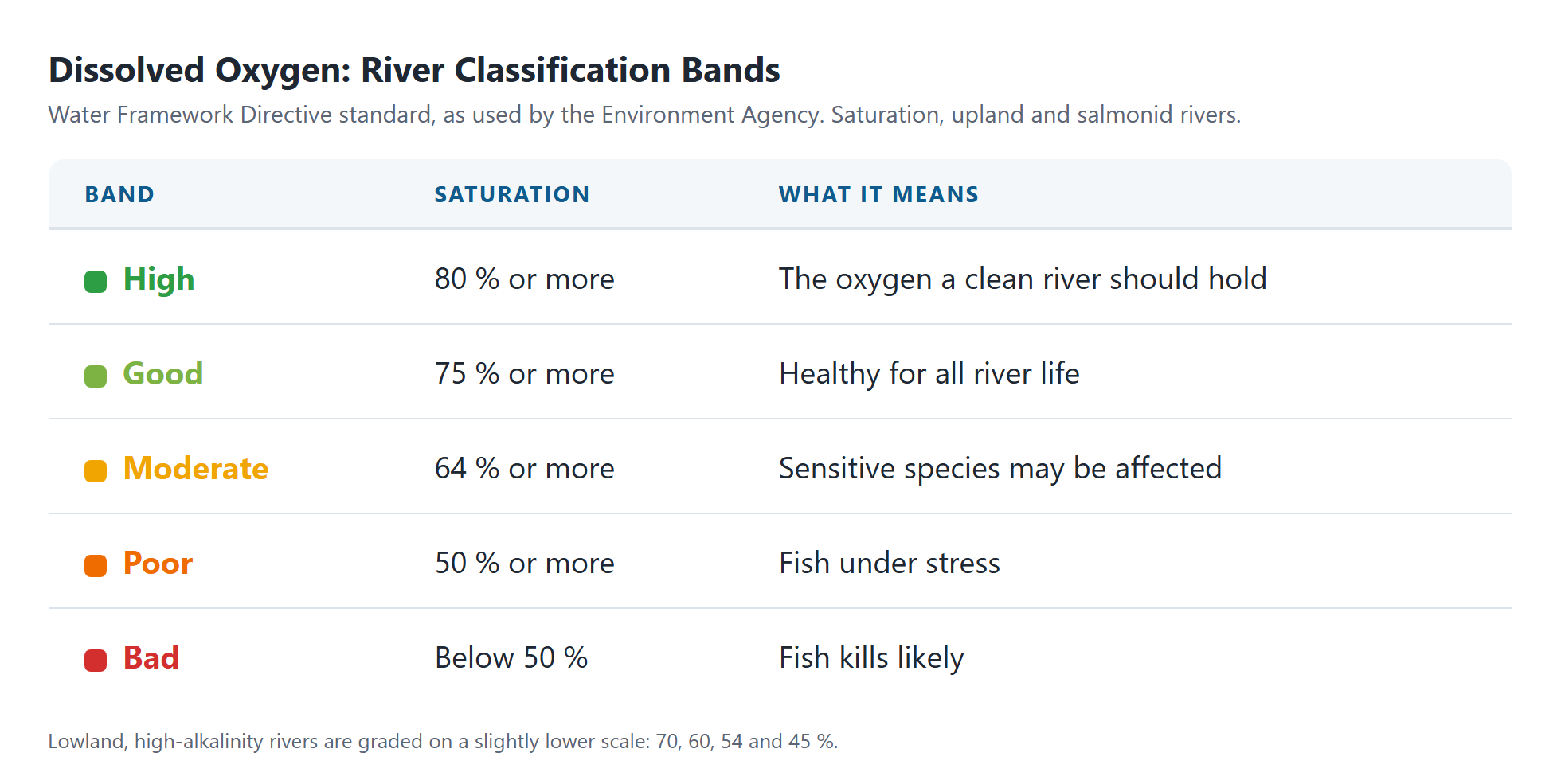
These are the bands for upland rivers and for any river with salmon or trout. Lowland, high-alkalinity rivers are graded on a slightly lower scale (70, 60, 54 and 45 %). The official classification is taken over a year of readings, as the level the river stays above nine days in ten; the portal shows the band the latest reading falls in, and keeps every reading so that longer view can be made.
Technical Specifications
Installation And Maintenance
The probe is supplied ready to use. Mount it in the water at a point that stays submerged at the lowest level the water reaches, clear of the bed so silt cannot settle on the sensing cap, and out of direct sunlight where possible. A short length of pipe or a bracket on the bank, with the probe hanging from its cable into the flow, is all that is needed; the NPT 3/4 thread takes a standard pipe fitting where a rigid mount is preferred. Flowing water is not required for a reading, so a still pond or a lake margin suits it as well as a river.
Run the 5 m cable to the camera and connect it to the sensor port. On the camera's Settings page, choose Dissolved Oxygen Probe and press OK; the camera reads the probe at once and confirms it has answered. From then on it reads on the schedule you set and reports with every status report. Commissioning takes a few minutes, and nothing needs configuring on the portal: the camera's page gains its Dissolved Oxygen section as soon as the first reading arrives.
The probe is supplied calibrated. The only consumable is the fluorescent sensing cap, which is replaced about once a year, a job of minutes with no tools. The probe needs no reagents, no membrane electrolyte and no stirring, and it tolerates the hydrogen sulphide of a silty, anaerobic bed that upsets electrochemical probes. Between cap changes, the only care it needs is a wipe of the cap if weed or biofilm builds up on it; the camera's own images will show you when.
Minutes to commission. Mount, plug in, choose the probe on the camera, done.
One cap a year. The only consumable, changed without tools.
Nothing to feed it. No reagents, no electrolyte, no flow.
Where It Is Used
Anywhere the oxygen in the water decides what lives in it.
Rivers and streams Continuous oxygen alongside the camera's view of the reach. The overnight low, the response to a storm or a hot spell, and the slow decline of a stretch under pressure, all in one record with the pictures that explain them.
Fisheries and angling waters Know before the fish do. The alarm catches a falling oxygen level while there is still time to aerate, and the record shows which weeks and which hours a stillwater runs lowest.
Discharges and consents Monitor the water below an outfall, a works or a farm, with the discharge in the camera's view. A reading that falls when the pipe is running is evidence; a reading that holds is reassurance, and both are kept.
Lakes, ponds and reservoirs Catch the afternoon supersaturation that warns of an algal bloom, and the night-time crash that follows it. Readings and images from the same spot, day after day, show a bloom building before it becomes a fish kill.
Pollution response When an incident is reported, the probe already on site shows when the oxygen fell and how far, and the camera shows what the water looked like at the time. The record is there before anyone has driven to the site.
Habitat and restoration projects Measure what a project has changed. A year of readings before and after gives a weir removal, a re-meander or a wetland the evidence of its effect on the water's oxygen, graded on the same standard the regulator uses.
Add Dissolved Oxygen To Your FloodEye Camera
The dissolved oxygen probe is an option on any FloodEye camera, new or already installed. An existing camera needs only the probe and a firmware update; the camera's sensor port, the portal pages and the alarm are all in place. One camera, one probe, one record of the water and the pictures that go with it.
Tell us about the water you need to watch and we will put together a system to suit it: the camera, the probe, the mounting and the cable length for your site.